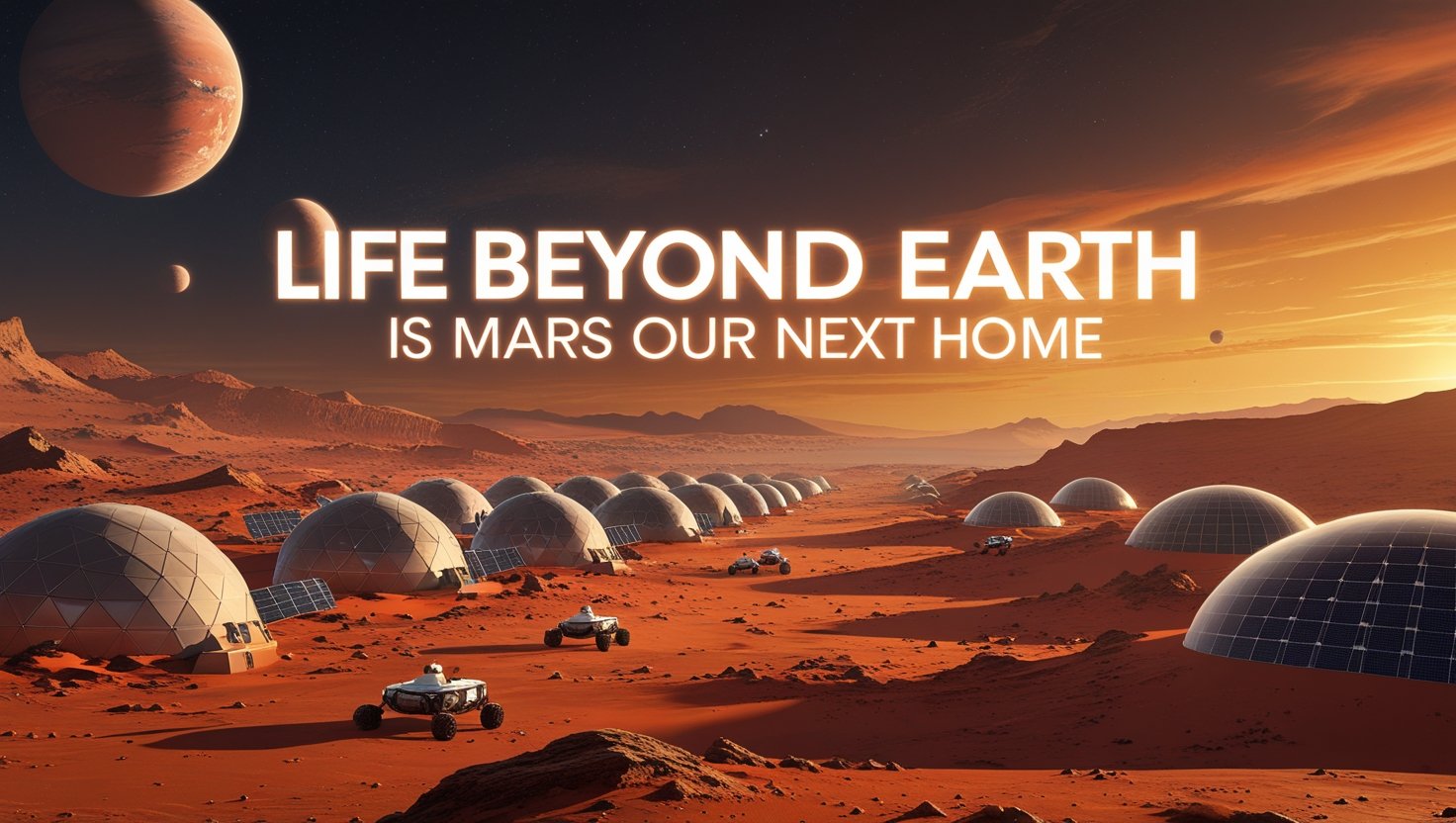
Imagine waking up to a rust-colored sky, the silhouette of Olympus Mons on the horizon, and the hum of life-support systems reminding you that Earth is a fading memory. That’s the thrilling promise of Life Beyond Earth, a journey where Mars beckons as our next home, challenging every assumption about human habitation, colonization, and interplanetary travel. Strap in, because the Red Planet’s calling, and it’s rewriting our future.
The Red Planet’s Allure:
Mars isn’t just another dot in the night sky. With day lengths staggering a mere 40 minutes longer than Earth’s and polar ice caps that expand and contract, it whispers of familiarity amid alien landscapes. Scientists call it Earth’s cousin, thin atmosphere, seasons, and evidence of ancient rivers underscore the tantalizing possibilities for sustainable living. But fascination alone won’t build colonies; it fuels the ambition to transform sci-fi dreams into brick-and-regolith realities.
Can We Make It Breatheable?
Mars’s atmosphere is 95 percent carbon dioxide and only 0.1 percent oxygen, far from breathable. Enter MOXIE, NASA’s experimental module that extracts oxygen from CO₂ through solid-oxide electrolysis. Early tests aboard Perseverance proved we can convert Martian air into life-support gas, delivering roughly 6 grams of O₂ per hour. Scale that up, and habitats could recycle air indefinitely, drastically cutting Earth-to-Mars cargo needs and edging us closer to self-sufficiency.
Building Sanctuaries in Dust:
Shipping steel and concrete 140 million miles isn’t viable. Instead, visionaries propose 3D printing with Martian regolith, that rusty dust covering the surface. ICON and AI SpaceFactory designs outline inflatable modules shielded by thick regolith shells to block radiation and insulate against temperature swings from –90 °C to +20 °C. These sand-castled habitats could rise within weeks, forging safe havens that blend seamlessly with the terrain, proving that colonization can harmonize with the environment.
Water in the Desert:
Liquid water streams may be long gone, but ice lurks at the poles and beneath mid-latitude soils. Rover data indicates deposits containing enough frozen H₂O to supply hundreds of settlers annually. Future settlers could drill subsurface ice, melt it in solar reactors, then purify it through freeze-thaw cycles. Beyond drinking, that water splits into hydrogen and oxygen for fuel and breathing, anchoring interplanetary travel networks, and enabling return trips with locally sourced propellant.
Growing Food Under Rust-Colored Skies:
Dependence on resupply ships is unsustainable. Hydroponics and aeroponics, tested aboard the ISS, will flourish in controlled greenhouses beneath transparent regolith domes. Imagine trays of lettuce bathed in LEDs tuned to photosynthetic peaks, tomatoes climbing trellises, and algae vats churning out protein supplements. Closed-loop nutrient cycles recycle waste, while nitrogen-fixing bacteria enrich Martian soil analogs. Over time, these micro-ecosystems could feed crews indefinitely, cementing sustainable living on Mars.
Radiation and Medicine on Mars:
Without Earth’s magnetic shield, settlers face galactic cosmic rays and solar flares delivering up to 0.67 sieverts annually, two to three times Earth’s background levels. Solutions span regolith-buried medical bays to electromagnetic shielding concepts that mimic Earth’s van Allen belts. Onboard labs equipped with gene-sequencing kits could monitor health, while telemedicine links specialists on Earth to surgeries or treatments. In this new world, healthcare merges cutting-edge biotech with age-old principles of community care.
Transportation and Infrastructure:
SpaceX’s Starship envisions 100 tons of cargo per launch, slashing costs to under $10 per kilogram. Paired with orbital refueling depots, round-trip missions become routine. Solar electric tugs could haul cargo between Phobos and Mars orbit, while pressurized all-terrain rovers lay down logistic corridors. Eventually, a network of Mars “airports” with vertically landing vehicles will shuttle between colonies, science outposts, and mining sites, sprouting a true interplanetary highway.
Living Beyond One Planet:
Mars isn’t a theme park; isolation, confinement, and the endless void challenge mental health. Crew psychology will depend on private quarters, virtual-reality “windows” opening onto Earth memories, and rotating duties to prevent monotony. Compact communities share meals under enclosed skylights, celebrating Earth holidays and Martian “Sol” anniversaries alike. In crafting a vibrant culture, pioneers prove that colonization isn’t just bricks and tech, it’s forging bonds under alien stars.
Conclusion:
Mars holds the blueprint for our first chapters of off-world living. From converting CO₂ into oxygen and printing homes from dust to tapping polar ice and mastering cosmic radiation, each breakthrough inches us toward becoming a multi-planet species. Life Beyond Earth isn’t a distant fable but a roadmap drawn in red dust and starlight. As rockets ignite and habitats rise, Mars may soon transform from cosmic curiosity into our next home, proof that humanity’s greatest adventures begin where comfort ends.
FAQs:
1. Can we breathe Martian air?
Not raw—MOXIE-style systems convert CO₂ into oxygen.
2. Where will Mars colonists get water?
By drilling and melting subsurface ice deposits.
3. How do we protect settlers from radiation?
Regolith shielding and magnetic deflector concepts.
4. What will Mars habitats be made of?
3D-printed regolith structures with inflatable cores.
5. How long is the trip to Mars?
Roughly six to nine months, depending on alignment.
6. Could a colony sustain itself?
Yes—with air recycling, hydroponic farms, and in-situ resources.