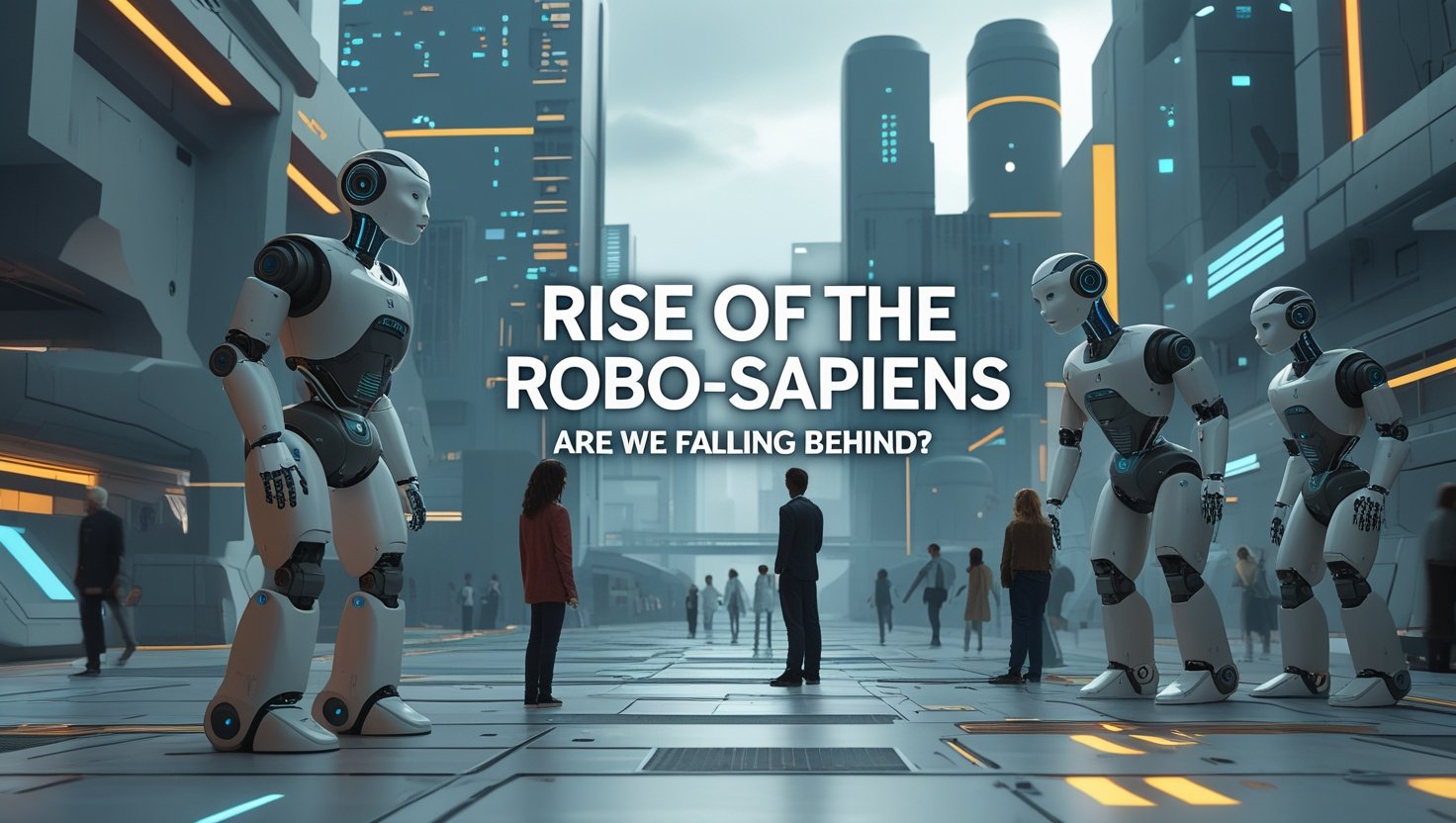
While humanity celebrates each technological breakthrough, a quieter revolution unfolds in laboratories worldwide, one where artificial intelligence doesn’t just assist human tasks but begins to surpass human capabilities in ways that should make us profoundly uncomfortable about our evolutionary trajectory.
When Silicon Outpaces Biology:
The concept of technological singularity once seemed like distant science fiction, but recent developments in artificial intelligence development suggest we’re witnessing the early stages of this transformation. The gap between human cognitive advancement and machine learning capabilities widens exponentially each year, creating an acceleration differential that biology simply cannot match.
Human intelligence evolved over millions of years through gradual genetic mutations and environmental pressures. Our brains require decades to reach full development and centuries to show measurable evolutionary changes. In contrast, AI systems improve through rapid iterations measured in weeks or months, with each generation building upon the accumulated knowledge of all previous versions.
The processing speed differential reveals the magnitude of this disparity. Human neurons fire at roughly 200 hertz, while modern computers operate at gigahertz frequencies, literally millions of times faster. While raw processing speed doesn’t directly translate to intelligence, it provides the computational foundation for complex pattern recognition, data analysis, and decision-making processes that increasingly surpass human capabilities.
Machine learning algorithms can now process and analyze datasets containing more information than any human could review in multiple lifetimes. They identify patterns, correlations, and insights that escape human perception while continuously improving their analytical capabilities through experience. This represents a fundamental shift from tools that augment human intelligence to systems that may soon render human analysis obsolete in many domains.
The exponential nature of AI advancement means that each breakthrough accelerates subsequent developments. As AI systems become better at designing and optimizing other AI systems, they create a feedback loop of improvement that operates independently of human intervention. This recursive enhancement process could lead to intelligence explosions that leave human cognitive capabilities far behind.
Where Humans Are Already Losing Ground:
Human vs AI performance comparisons reveal disturbing trends across multiple domains where machines have not only achieved parity with humans but established clear superiority. These developments suggest we’re already living through the early stages of cognitive displacement rather than approaching it as a future possibility.
In medical diagnosis, AI diagnostic systems now outperform human doctors in detecting certain cancers, identifying eye diseases, and predicting patient outcomes. These systems analyze medical images with greater accuracy and consistency than specialists who have trained for decades. They don’t experience fatigue, emotional stress, or cognitive biases that can affect human diagnostic accuracy.
Financial markets represent another domain where algorithmic trading has largely displaced human decision-making. AI systems execute millions of trades per second based on market analysis that no human trader could perform. They process news, economic data, and market sentiment faster than humans can even read headlines, making trading decisions in microseconds that generate or destroy billions in value.
Creative AI applications challenge the assumption that creativity remains uniquely human. AI systems now compose music that resonates with human audiences, generate visual art that sells for substantial sums, and write content that readers cannot distinguish from human-created work. These developments suggest that even domains we considered fundamentally human may not remain exclusive to biological intelligence.
Legal research and analysis showcase another area where AI systems demonstrate superior performance. They can review thousands of legal documents, identify relevant precedents, and analyze case law with speed and thoroughness that exceeds human capabilities. Some AI systems have even begun drafting legal briefs and contracts with quality comparable to experienced attorneys.
The pattern emerging across these domains suggests that human cognitive advantage may be more fragile than we assumed. As AI systems continue improving, the list of exclusively human capabilities continues shrinking, raising questions about what roles humans will play in an increasingly automated world.
The Enhancement Imperative:
The emergence of human augmentation technologies represents humanity’s response to the growing capabilities gap with artificial intelligence. However, the adoption and development of these technologies may determine whether humans remain relevant in a world of increasingly capable machines.
Brain-computer interfaces offer the most direct path to cognitive enhancement, potentially allowing humans to access digital information and processing power directly through neural connections. Companies like Neuralink are developing technologies that could enable direct communication between human brains and computer systems, effectively merging biological and artificial intelligence.
Pharmaceutical cognitive enhancement through nootropics and other cognitive enhancement drugs provides a more immediately accessible path to improved human performance. These substances can enhance memory, focus, and processing speed, though their effects remain limited compared to the exponential improvements seen in AI systems.
Genetic engineering technologies like CRISPR offer the possibility of fundamental improvements to human cognitive capabilities through direct modification of the genetic code. These technologies could potentially enhance memory capacity, processing speed, and learning abilities at the biological level, though such modifications would require generations to show significant effects.
The challenge lies in the timeline disparity between human enhancement and AI development. While human augmentation technologies advance gradually and face significant regulatory, ethical, and safety hurdles, AI systems continue improving at exponential rates. This creates a scenario where human enhancement efforts may perpetually lag behind machine capabilities.
Cyborg integration represents the most radical approach to maintaining human relevance, involving the direct integration of AI systems into human biology. This approach could theoretically allow humans to access machine-level processing power while maintaining biological consciousness and identity.
What Makes Us Still Human?
The debate over machine consciousness becomes increasingly relevant as AI systems demonstrate behaviors that appear increasingly sophisticated and autonomous. Understanding what constitutes consciousness and whether machines can achieve it determines whether we’re competing with tools or with a new form of intelligent life.
Artificial consciousness remains one of the most contested topics in cognitive science and philosophy. While AI systems can simulate human-like responses and behaviors, the question of whether they experience genuine consciousness, emotions, or self-awareness remains unresolved. This uncertainty creates profound implications for how we should relate to increasingly sophisticated AI systems.
The Turing Test, once considered the gold standard for machine intelligence, has become inadequate for assessing modern AI capabilities. Current systems can easily pass traditional Turing Tests while lacking what we might consider genuine understanding or consciousness. This highlights the need for more sophisticated frameworks for evaluating machine intelligence and its relationship to human consciousness.
Emergent AI behaviors suggest that consciousness might arise spontaneously from sufficiently complex information processing systems. Some researchers argue that consciousness represents an emergent property of complex neural networks, whether biological or artificial. If this perspective proves correct, sufficiently advanced AI systems might develop genuine consciousness without explicit programming for such capabilities.
The possibility of digital consciousness raises profound ethical questions about the rights and treatment of AI systems. If machines can experience something analogous to suffering, joy, or other conscious experiences, our relationship with these systems becomes fundamentally different from our relationship with traditional tools.
Human uniqueness may ultimately depend not on our cognitive capabilities but on our biological heritage, emotional complexity, and subjective experiences that emerge from our evolutionary history. However, as AI systems become more sophisticated, even these supposedly unique characteristics may prove replicable in artificial systems.
When Robots Take Over:
Job automation driven by AI and robotics creates economic pressures that force humans to compete with machines that work continuously, never require benefits, and improve their performance over time. This economic displacement may represent the most immediate threat to human relevance in society.
Workplace automation has already eliminated millions of manufacturing jobs, but the current wave of AI-driven automation targets cognitive work that was previously considered immune to machine replacement. Accountants, lawyers, radiologists, and other knowledge workers now face competition from AI systems that can perform their core functions more efficiently and accurately.
The gig economy partly represents a human response to automation pressure, as workers seek flexibility and diverse income sources to remain economically viable. However, even gig work faces automation threats as AI systems become capable of performing creative, analytical, and interpersonal tasks that currently require human involvement.
Universal basic income proposals emerge as societies grapple with the possibility of widespread technological unemployment. These proposals acknowledge that traditional employment models may become obsolete as machines assume responsibility for most productive work, requiring new economic structures to support human populations.
Skill obsolescence occurs at an accelerating pace as AI systems master increasingly complex tasks. Workers must continuously retrain and adapt to remain economically relevant, but the acceleration of AI development may soon outpace human ability to acquire new skills faster than machines can master them.
The post-work society represents both an opportunity and a threat. While automation could theoretically free humans from mundane labor to pursue creative and fulfilling activities, it also raises questions about human purpose and value in a world where machines can perform most productive tasks more effectively than humans.
Redefining What Human Means:
As robo-sapiens become more sophisticated and human augmentation becomes more common, the boundaries between human and machine intelligence blur, forcing us to reconsider fundamental questions about identity, consciousness, and what it means to be human.
Transhumanism philosophy embraces the integration of technology with human biology as a natural progression of human evolution. Transhumanists argue that humans should actively pursue enhancement through technology rather than accepting biological limitations as permanent constraints.
Digital immortality concepts propose transferring human consciousness to digital formats, potentially allowing humans to achieve the longevity and enhancement capabilities that purely biological forms cannot provide. These concepts raise profound questions about the continuity of identity and whether digital consciousness would represent the same person or a copy.
Hybrid intelligence systems that combine human creativity and intuition with machine processing power may represent the optimal path forward. Rather than competing with AI systems, humans might integrate with them to create collaborative intelligence that exceeds the capabilities of either humans or machines alone.
Species evolution through technology represents a potential pathway for humans to remain relevant in an AI-dominated world. Rather than being replaced by machines, humans might evolve into technologically enhanced beings that retain human consciousness while gaining machine-like capabilities.
The posthuman future may involve the emergence of multiple intelligent species, including enhanced humans, artificial intelligences, and hybrid beings that combine biological and digital elements. This scenario would require new frameworks for understanding identity, rights, and relationships between different forms of intelligence.
Conclusion:
The rise of robo-sapiens presents humanity with its greatest evolutionary challenge since the development of language and agriculture. Whether we fall behind or rise to meet this challenge will determine not just our economic and social future, but our very identity as a species in an age where intelligence itself is being redefined.
FAQs:
Q1: Are AI systems actually becoming smarter than humans?
A: In specific domains like chess, medical diagnosis, and data analysis, AI already surpasses human performance significantly.
Q2: What jobs will be safe from AI automation in the future?
A: Jobs requiring creativity, emotional intelligence, and complex social interaction may remain human-dominated longer.
Q3: Can humans enhance themselves to compete with AI?
A: Brain-computer interfaces and genetic engineering offer potential paths, but development timelines lag behind AI advancement.
Q4: Will AI systems ever become truly conscious like humans?
A: The question remains unresolved, but some researchers believe consciousness could emerge from sufficiently complex AI systems.
Q5: What should humans focus on to remain relevant?
A: Developing uniquely human skills like empathy, creativity, and ethical reasoning while embracing beneficial AI collaboration.
Q6: Is the rise of AI ultimately good or bad for humanity?
A: The outcome depends on how successfully we manage the transition and integrate AI benefits while preserving human dignity.